 CatchScan
The short answer
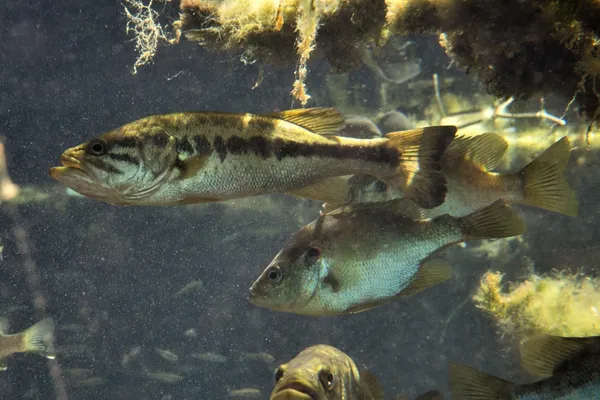
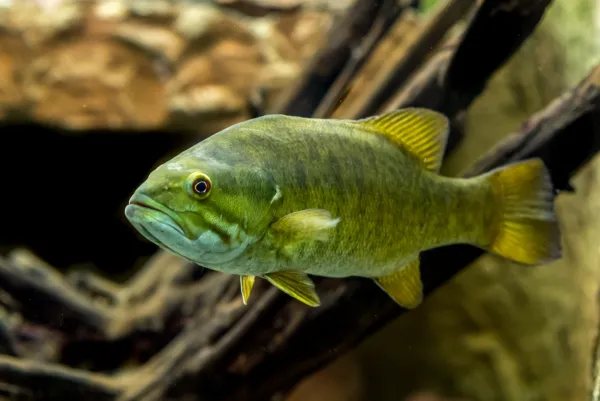
Close the fish's mouth and look at where the upper jaw ends. On an adult largemouth it reaches well behind the back edge of the eye. On a smallmouth it stops at or before that edge. Then look at the side. A largemouth has a dark stripe running from head to tail, and a smallmouth has a row of faint vertical bars and no stripe.
The marks, one at a time
Jaw
- Largemouth: with the mouth closed, the upper jaw extends well behind the back margin of the eye.
- Smallmouth: the upper jaw reaches to about the back margin of the eye and never beyond it.
Texas Parks and Wildlife and the Missouri Department of Conservation both use this mark. Missouri's field guide notes that the largemouth's long jaw holds "except in small young", so a fish a few inches long needs the other marks.
Side pattern
- Largemouth: a broad, dark stripe runs along the middle of the side. It can break into a row of blotches.
- Smallmouth: no horizontal stripe. The side is plain, with a series of separate vertical bars that are often faint.
Dorsal fin
- Largemouth: the spiny front part and the soft rear part are nearly divided.
- Smallmouth: the two parts are connected.
Color
- Largemouth: greenish above, with white lower sides and belly.
- Smallmouth: brownish green, and the white of the belly does not extend high on the sides. Its other names are bronzeback and brown bass.
Color shifts with the water. The U.S. Geological Survey describes largemouth ranging from silvery white to brassy green, and occasionally light brown in darker water. Use color only to back up the jaw and the side pattern.
Cheek and tongue
Two marks need a close look. Missouri's field guide says a largemouth's cheek scales are the same size as its body scales and its tongue is smooth. A smallmouth's cheek scales are much smaller than its body scales, and its tongue usually has a rough patch.
Where each one lives
Habitat only hints at the species. The Missouri Department of Conservation places largemouth in lowland lakes, impoundments of all sizes, permanent pools of streams and quiet river backwaters, in warm, moderately clear water with little or no current. It places smallmouth in cool, clear streams with silt-free rock or gravel bottoms and in large reservoirs. Texas Parks and Wildlife adds large clear-water lakes for smallmouth.
The two overlap: Missouri's field guide puts both in reservoirs. Both also live far outside their native ranges now. Texas Parks and Wildlife says few states are left where smallmouth have not become established, and describes Florida and Louisiana as apparently free of them.
Size
Size rarely separates the two: Missouri's field guide gives both species a usual total length of 10 to 20 inches. The largemouth grows heavier: its maximum in Missouri is about 24 inches and 15 pounds, against about 22 inches and 6 pounds for smallmouth.
The spotted bass in between
The fish that breaks the two-mark test is the spotted bass, also called Kentucky bass. It has a dark stripe along the side like a largemouth and a shorter jaw like a smallmouth: in adults the jaw reaches to the back of the eye or only slightly beyond it. Missouri's field guide lists these identifiers:
- dark spots on the lower side arranged in rows, which form horizontal streaks
- a rough patch on the tongue
- connected dorsal fins
- very small cheek scales
- in juveniles, a black spot at the base of the tail fin
So when a bass has the side stripe but its jaw stops near the eye, look below the stripe for rows of spots. Texas Parks and Wildlife lists spotted, Guadalupe and Alabama bass under one set of marks.
Why the name matters for the rules
States can set different limits for different black bass, and Texas is one example. Its statewide freshwater limits, valid from 1 September 2026 through 31 August 2027 and read on 16 November 2026, set a 14-inch minimum length for largemouth and for smallmouth bass, and no minimum length for spotted, Guadalupe and Alabama bass. All five share one daily bag of 5 fish, and certain waters have their own exceptions.
That is one state's rule for one season. Limits change and differ from water to water, so check the current rules from the fish and wildlife agency for the place you are fishing before you keep a bass. Our guide to size and bag limits explains how these rules work.
Checking a photo with CatchScan
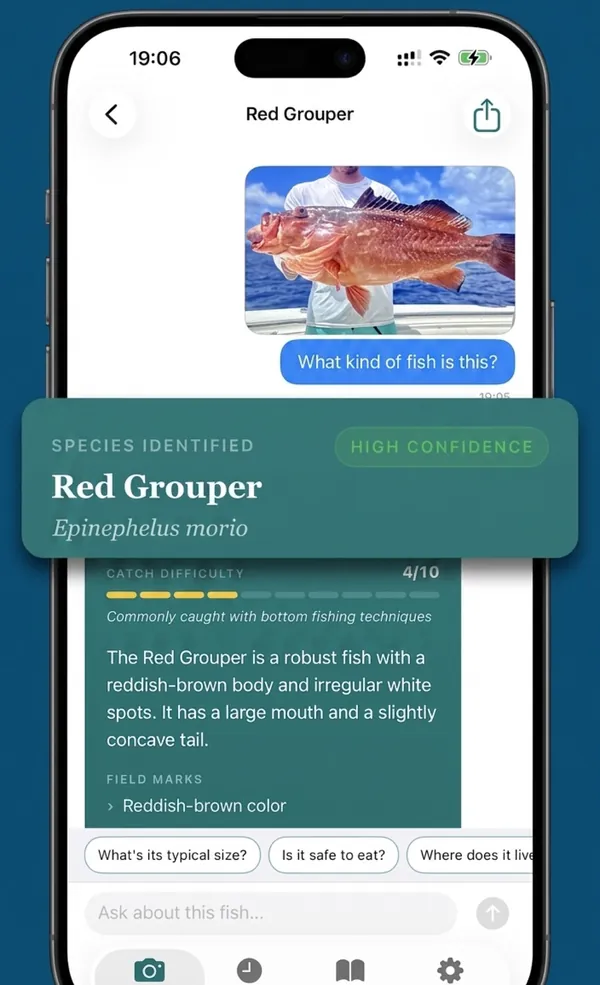
Fish Identifier: CatchScan names a fish from a photo. The result shows the species with a confidence level of high, medium or low. Under "Field marks" it lists the features of the fish it named, and under "Don't confuse with" it names look-alike species with a line on how to tell each one apart.
When the scan has a location, the result can add a "Local regulations" panel, with the date the rules shown were in force. The app is a reference tool and not legal advice. Always confirm with the official authority before you keep a fish.
Whether you check by eye or with the app, a side-on photo with the mouth closed shows the jaw, the side pattern and the dorsal fin in one frame. Our photo guide covers framing, and the look-alike guide covers other pairs such as walleye and sauger.
Sources
- Missouri Department of Conservation, field guide: Largemouth Bass, Smallmouth Bass and Spotted Bass, read 16 November 2026
- Texas Parks and Wildlife Department: Bass Comparison and Identification, Largemouth Bass, Smallmouth Bass and Freshwater Bag and Length Limits, read 16 November 2026
- U.S. Geological Survey, Nonindigenous Aquatic Species: Largemouth Bass fact sheet, read 16 November 2026
- Photos from the U.S. Fish and Wildlife Service media library, public domain: Largemouth bass (Ryan Hagerty/USFWS) and Smallmouth bass (Brett Billings/USFWS), read 16 November 2026