 CatchScan
The short answer
Place the fish in a group first, from its body shape and fins. Then check two or three marks that separate the species inside that group: how far the upper jaw reaches, the pattern on the side, the shape of the tail. The marks here are the Missouri Department of Conservation's unless an entry names another agency. For the fish of your own state, start from the agency guides listed further down.
The big freshwater groups and how to tell them apart
Black bass (largemouth, smallmouth, spotted)
- Largemouth bass: the upper jaw reaches far beyond the rear margin of the eye, except in small young. A broad, dark, continuous stripe runs along the midside, and the tongue is smooth.
- Smallmouth bass: the upper jaw reaches to about the rear margin of the eye. The side is plain with a series of separate vertical bars and no dark horizontal stripe, and the two dorsal fins are connected.
- Spotted bass: the upper jaw reaches to or only slightly beyond the back of the eye. It has a broad, dark stripe along the midside like the largemouth's, dark spots in rows on the lower side and a rough patch on the tongue.
The jaw separates a largemouth from the other two and nothing more. Between a smallmouth and a spotted bass, look at the side: bars and no stripe on the smallmouth, a stripe and rows of spots on the spotted bass. Our largemouth vs smallmouth bass guide takes the marks one at a time.
Trout (rainbow, brown, brook)
- Rainbow trout: a pink or reddish stripe along the side, dark olive upper parts thickly speckled with black spots, and prominent dark spots on a forked tail. The side has no orange or reddish spots.
- Brown trout: round black spots on the body and dorsal fin, and small red or orange spots, each surrounded by a lighter halo. The tail is usually not forked and usually without spots.
- Brook trout: a char. As a rule, the National Park Service says, char have pale markings on a dark body and the true trout have dark spots on a lighter one. It describes breeding males with an olive back in a pale vermiculate (worm-like) pattern, small red spots haloed with pale blue on the sides, and lower fins with milky white margins and a black streak just above them. Other adults are similar, with less contrast.
The tail is a quick check between a rainbow and a brown trout: forked and spotted on the rainbow, usually unforked and unspotted on the brown.
Sunfish and crappie (bluegill, green sunfish, redear, crappie)
- Bluegill: a small mouth, with the upper jaw not reaching past the front of the eye, a black ear flap, and often a black blotch near the back of the dorsal fin. The chin and the lower part of the gill cover are blue.
- Green sunfish: a thick body and a large mouth, with the upper jaw reaching to about the middle of the eye. It has blue mottlings and streaks on the side of the head, and a rounded pectoral fin. The bluegill's is long and pointed.
- Redear sunfish: a small mouth like the bluegill's, and a black ear flap with a whitish border and a prominent orange or red spot.
- Black crappie: a silvery, slab-sided fish with irregularly arranged speckles and blotches, and 7 or 8 spines in the dorsal fin.
- White crappie: the same shape, with 5 to 10 faint, regularly arranged vertical bars, and usually 6 spines in the dorsal fin.
Catfish (channel, blue, flathead)
- Channel catfish: a deeply forked tail, scattered dark spots on the back and sides, and an anal fin with a rounded outer margin and usually 24 to 29 rays. The spots are often absent in the smallest young and in large adults.
- Blue catfish: a deeply forked tail and never dark spots. The anal fin is straight-edged with 30 to 35 rays, and the head and forward part of the body look wedge-shaped from the side.
- Flathead catfish: a tail that is squared off with a slight notch and not deeply forked, a broad, flattened head, and a lower jaw that projects beyond the upper. The body is often strongly mottled with brown or black.
Missouri's field guide notes that channel catfish sometimes mate with blue and flathead catfish, and that the hybrids blend traits of both parents.
Walleye & sauger
- Walleye: two separate dorsal fins, the first streaked and blotched with black, usually with a large black blotch near the bases of its last few spines. Texas Parks and Wildlife adds a light tip on the lower lobe of the tail.
- Sauger: distinct dark blotches, or "saddle marks", on the sides and dark spots on the first dorsal fin, with no dark blotch near the base of its last few spines. The lower lobe of the tail has no white blotch, or a reduced one.
The two occasionally interbreed where their ranges overlap. The hybrid, the saugeye, shares characteristics of both parents, which makes it difficult to identify.
Pike, muskellunge and pickerel
All three have a duckbill-shaped snout, a large mouth with many sharp teeth and a single dorsal fin set far back, near the tail.
- Northern pike: light spots against a darker background. The cheek is fully scaled, and the gill cover is scaled only on its upper half.
- Muskellunge: dark spots or bars on a light background. The cheek and the gill cover are both scaled only on their upper halves.
- Chain pickerel: a chainlike pattern of dark lines on an olive or yellowish-brown side. The cheek and the gill cover are both fully scaled.
A northern pike has light marks on a dark side, and a muskellunge has dark marks on a light one. Where the pattern is unclear, compare the scales on the cheek and the gill cover.
Why the species matters for the rules
Fishing rules are written species by species. Texas, for one, sets its statewide freshwater limits by species and lists exceptions for named locations. A wrong name can mean applying the wrong rule. Limits change, so check the current rules from the fish and wildlife agency for the water you are fishing before you keep a fish. Our size and bag limits guide explains how these rules work.
Official guides for your state
State and federal agencies publish identification pages:
- Missouri Department of Conservation, Field Guide, which can be searched, or browsed by type, fishes among them.
- Texas Parks and Wildlife Department, Bass Comparison and Identification, with labeled marks for the black basses and for yellow, white, striped and hybrid striped bass.
- Florida Fish and Wildlife Conservation Commission, freshwater fish profiles, which can be filtered to native or nonnative fish.
- U.S. Fish and Wildlife Service, Freshwater Fish of America, a collection on largemouth bass, walleye, catfish, crappie, northern pike, trout and other fish, with the natural history of each.
Identifying a freshwater catch with CatchScan
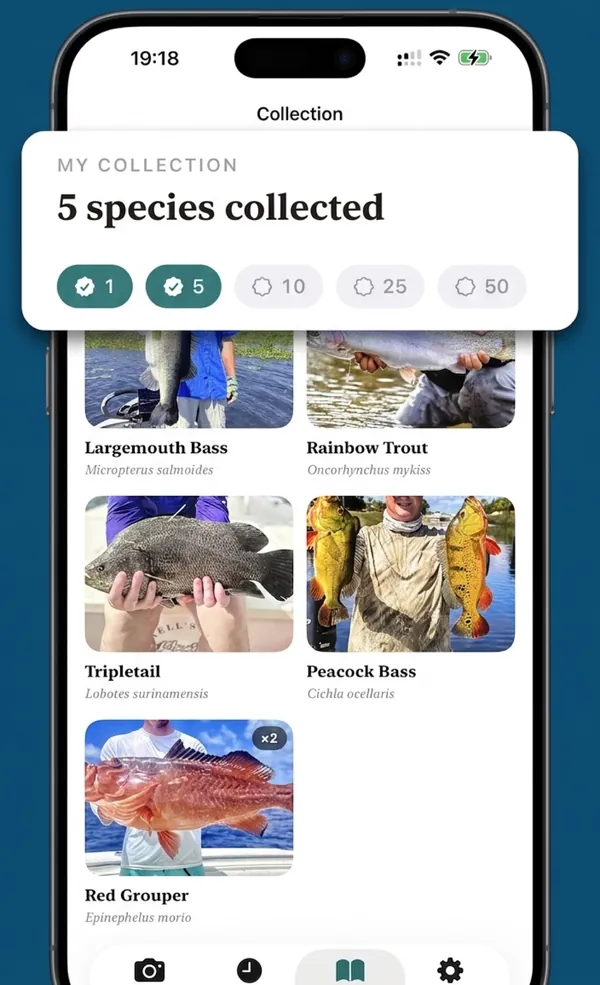
To check a catch with Fish Identifier: CatchScan:
- Photograph your catch (framing tips in our photo-ID guide).
- Read the result. It names the species with a confidence level of high, medium or low. Under "Field marks" it lists the features of the fish it named, and under "Don't confuse with" it names look-alike species with a line on how to tell each one apart. An uncertain result uses a broader name.
- Check the rules for that water. Freshwater limits are often specific to one lake or river. When the scan has a location, the result can add a "Local regulations" panel with rows for size, bag and season, and the date the rules shown were in force. The app is a reference tool and not legal advice. Always confirm with the official authority before you keep a fish (see size and bag limits explained).
- Ask follow-up questions Premium such as "Is this a hybrid?", "Best bait for these?" or "Is it good eating?" (see our edibility guide).
Your catch history
Every freshwater catch you identify is saved with its photo and conversation, and the history can be searched. For other pairs that are easy to confuse, such as walleye and sauger, see fish species that look alike.
Sources
- Missouri Department of Conservation, Field Guide: Largemouth Bass, Smallmouth Bass, Spotted Bass, Rainbow Trout, Brown Trout, Bluegill, Green Sunfish, Redear Sunfish, Black Crappie, White Crappie, Channel Catfish, Blue Catfish, Flathead Catfish, Walleye, Sauger, Northern Pike, Muskellunge and Chain Pickerel, read 17 November 2026.
- National Park Service, Shenandoah National Park, Brook Trout, read 17 November 2026.
- Texas Parks and Wildlife Department, Walleye and Freshwater Bag and Length Limits, read 17 November 2026.
- The agency guides listed under "Official guides for your state", read 17 November 2026.