 CatchScan
The short answer
Place the fish in a family first, from its body shape and fins. Then check two or three marks that separate the species inside that family: a spot at the base of the tail, barbels under the chin, the path of the lateral line. The marks here are the Florida Fish and Wildlife Conservation Commission's, so they cover fish found in Florida's waters. For another coast, start from the agency guides listed further down.
Sorting an ocean catch by family first
Drums: red drum, black drum and spotted seatrout
- Red drum (redfish): a copper-bronze body, one or more dark spots at the base of the tail (occasionally none) and no barbels on the lower jaw.
- Black drum: barbels on the lower jaw and a high-arched gray or black back. Juveniles have 4 to 6 dark vertical bars that fade with age.
- Spotted seatrout (speckled trout): black spots on the back that extend to the dorsal fins and tail, a pair of large canine teeth at the tip of the upper jaw and no barbels.
The chin settles red against black drum: a black drum has barbels and no tail spot. The bars on a young black drum resemble a sheepshead's, but the sheepshead has no barbels.
Jacks: crevalle jack, greater amberjack and Florida pompano
- Crevalle jack: a deep body with a steep front to the head, a prominent black spot on the gill cover and another at the base of each pectoral fin. The blue runner lacks the spot at the pectoral fin.
- Greater amberjack: a dark stripe from the nose to the front of the dorsal fin, an olive green or brownish back and no scutes (bone-like projections) on the body.
- Florida pompano: a deep, compressed body with a small mouth, and a dorsal fin that begins in front of the anal fin. On the permit, which grows much larger, the dorsal fin begins over the anal fin.
Snappers: gray (mangrove) and red
- Gray snapper (mangrove snapper): dark brown or gray with red-orange spots in bars along the sides, and two large canine teeth near the front of the upper jaw. Young fish have a dark stripe from the snout through the eye.
- Red snapper: a pinkish-red body, a long triangular snout, a red eye and an anal fin that is pointed at the rear. Adults have no dark spot on the sides. The silk snapper has a yellow eye, and the vermilion snapper has a rounded anal fin.
Groupers: red and gag
- Red grouper: a brownish-red body with irregular white blotches on the sides, a mouth lined in scarlet-orange and a long second spine in the dorsal fin. The Nassau grouper has a large black spot at the base of the tail, and the red grouper has none.
- Gag: brownish-gray with dark worm-like markings on the sides, and a strong serrated spur at the bottom of the cheek. On the black grouper that spur is gently rounded.
Mackerels and tunas
- Spanish mackerel: irregular golden-yellow spots on the sides, a bluish-black blotch at the front of the first dorsal fin and a lateral line that slopes gently toward the tail.
- King mackerel: no spots on adults, no dark blotch on the first dorsal fin and a lateral line that drops sharply below the second dorsal fin. Juveniles may have yellowish spots like a Spanish mackerel's, so check the lateral line and the fin.
- Blackfin tuna: a bronze stripe on the sides, dark finlets with white edges and a long pectoral fin. The yellowfin tuna has elongated second dorsal and anal fins.
- Little tunny (bonito): broken, wavy dark stripes on the back and 3 to 7 dark spots under each pectoral fin. The Atlantic bonito lacks those spots.
Flounders and halibut
- Gulf flounder: both eyes on the left side, and three prominent eyelike spots that form a triangle.
- Southern flounder: both eyes on the left side. It may have five or more dark spots and blotches, but they are not eyelike.
- Summer flounder: five or more eyelike spots on the body.
- Pacific halibut: NOAA Fisheries describes a flat, diamond-shaped body whose upper side is mottled gray to dark brown, with a white underside.
Cobia, tarpon and great barracuda
- Cobia: a long, slim fish with a broad, depressed head, a dark stripe along the side from the eye to the tail and a lower jaw that projects past the upper.
- Tarpon: bright silver sides, very large scales, a large mouth that points upward and one dorsal fin whose last ray extends into a long filament.
- Great barracuda: prominent, sharp teeth, a lower jaw that protrudes past the upper and black blotches on the lower sides.
Why the species matters for the rules
Fishing rules are written species by species. Florida's agency lists its recreational regulations by species for state waters, and points to federal regulations beyond them. A wrong name can mean applying the wrong rule. Limits change, so check the current rules from the fisheries agency for the water you are fishing before you keep a fish. Our size and bag limits guide explains how these rules work.
Official guides for your coast
Other coasts have other fish, and state fisheries agencies publish identification pages for their own waters:
- Florida Fish and Wildlife Conservation Commission, saltwater species profiles, and its Reef Fish Identification Guide to snappers, groupers, amberjacks and other reef fish.
- North Carolina Division of Marine Fisheries, Species Profiles, sorted into inshore and offshore fish, with species that are commonly mistaken for each other, such as the flounders, on one page.
- Massachusetts Division of Marine Fisheries, saltwater species profiles, including Atlantic cod and striped bass.
- NOAA Fisheries, Species Directory, which can be filtered by region, including Alaska, the West Coast and the Pacific Islands.
Identifying a saltwater catch with CatchScan
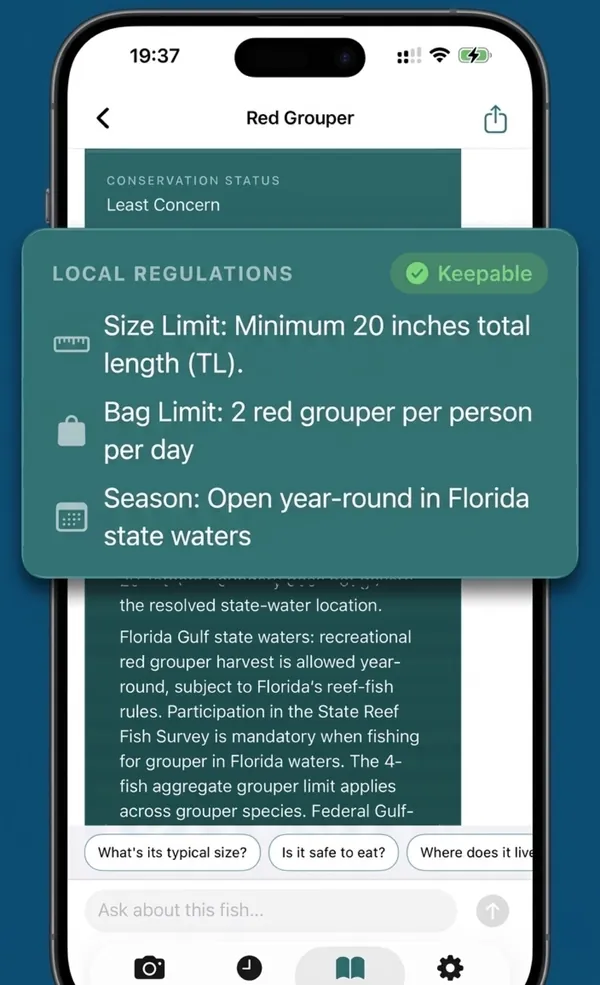
- Photograph the fish on deck, side-on with the fins visible (see how to photograph fish for ID).
- Read the result. It names the species with a confidence level of high, medium or low. Under "Field marks" it lists the features of the fish it named, and under "Don't confuse with" it names look-alike species with a line on how to tell each one apart. An uncertain result uses a broader name.
- Check the local rules. Saltwater seasons and slot limits change by state and zone. When the scan has a location, the result can add a "Local regulations" panel with rows for size, bag and season, and the date the rules shown were in force. The app is a reference tool and not legal advice. Always confirm with the official authority before you keep a fish. Our size and bag limits guide has more.
- Ask follow-up questions Premium such as "Is it safe to eat?" (ciguatera is a saltwater risk; see our edibility guide), "How big do these get?" or "Is this a good one to release?"
Your catch log
Every saltwater catch you identify is saved with its photo and conversation, and the history can be searched. For a pair that is easy to confuse, such as Spanish and king mackerel, see fish species that look alike.
Sources
- Florida Fish and Wildlife Conservation Commission, saltwater species profiles: Red Drum, Black Drum, Spotted Seatrout, Crevalle Jack, Greater Amberjack, Florida Pompano, Gray Snapper, Red Snapper, Red Grouper, Gag Grouper, Spanish Mackerel, King Mackerel, Blackfin Tuna, Little Tunny, Gulf Flounder, Southern Flounder, Cobia, Tarpon and Great Barracuda, read 16 November 2026.
- Florida Fish and Wildlife Conservation Commission, Recreational Regulations (the list of regulations by species), read 16 November 2026.
- NOAA Fisheries, Pacific Halibut, read 16 November 2026.
- The agency guides listed under "Official guides for your coast", read 16 November 2026.