 CatchScan
Why lookalikes matter
Confusing two similar species is how well-meaning anglers end up with violations, because the lookalike is often the one with the tighter limit or the closed season. Chinook and coho run the same rivers under different rules, and king and Spanish mackerel share the same water with very different size limits. Fishing legally means knowing the differences, or carrying something that does. (See size & bag limits explained.)
Commonly confused species
Chinook (king) salmon vs coho (silver) salmon
- Gums: Chinook have black gums at the base of the teeth; coho gums are whitish.
- Tail spots: Chinook carry small spots across both tail lobes; coho only on the upper lobe.
- Body: Chinook are stouter and typically larger, but a big coho and a small king overlap in size, so the gums and tail decide it.
Largemouth vs smallmouth vs spotted bass
- Jaw: past the back of the eye = largemouth; to about the back of the eye = smallmouth and spotted, so the jaw alone won't separate those two.
- Pattern: horizontal dark band = largemouth; vertical bronze bars = smallmouth; spot rows below the lateral line = spotted bass.
Our largemouth vs smallmouth bass guide takes these marks one at a time.
Walleye vs sauger
- Tail: walleye have a white tip on the lower tail lobe; on sauger the white tip is missing or reduced.
- Dorsal fin: streaked and blotched with black on walleye, usually with a large black blotch near the base of the last few spines; dark spots and no such blotch on sauger.
Spanish mackerel vs juvenile king mackerel
- Lateral line: drops sharply mid-body on a king; slopes gently on a Spanish.
- Dorsal fin: black-tipped on a Spanish, pale on a king. Both have golden spots, and their regulations differ a lot.
Black crappie vs white crappie
- Pattern: scattered speckles = black crappie; faint vertical bars = white crappie.
- Dorsal spines: 7 or 8 on black, 5 or 6 on white.
Checking the marks with CatchScan
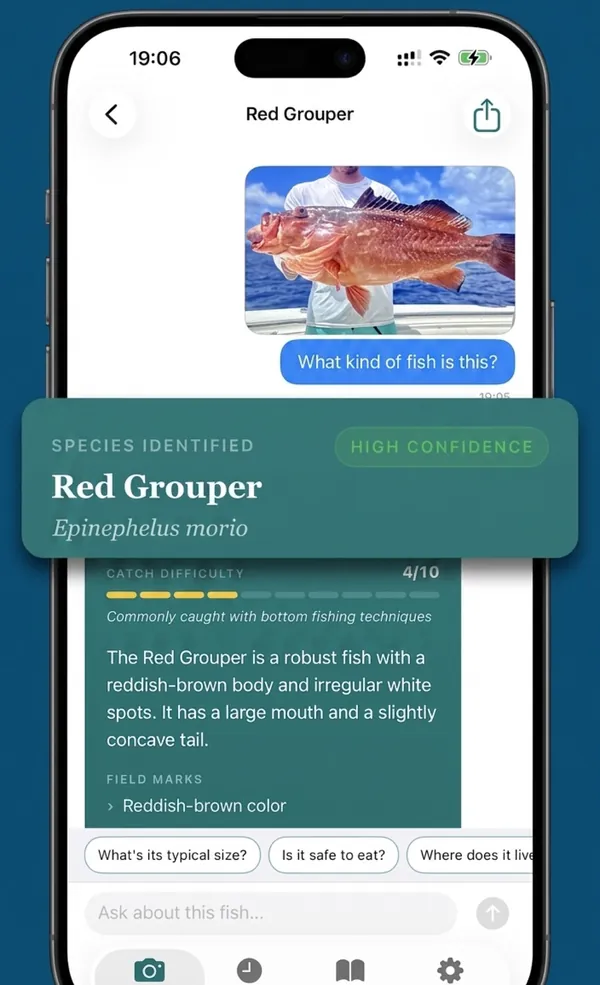
Fish Identifier: CatchScan gives you the species along with the field marks it based the call on:
- Snap the fish. The AI weighs the same kinds of features described above and returns a confidence rating with the match.
- Read the reasoning: for example, "black gums, small spots across both tail lobes, not the upper-lobe-only spots of a coho".
- Ask the comparison directly Premium: "How would I know if this was a coho?" The chat compares the two species side by side.
- Check the rules: the result includes the size, bag and season rules for the water where the photo was taken, so you can see whether the fish you're holding is the one with the closed season.
Learning the marks
Because CatchScan explains every identification, you pick up the field marks as you use it, and after a season you may spot the gums before the app does. Your catch history also keeps a record of the pairs you've puzzled over. For more species, see our saltwater and freshwater identification guides.