 CatchScan
The short answer
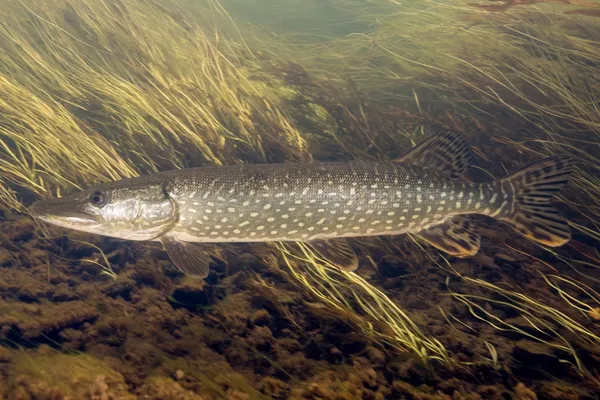
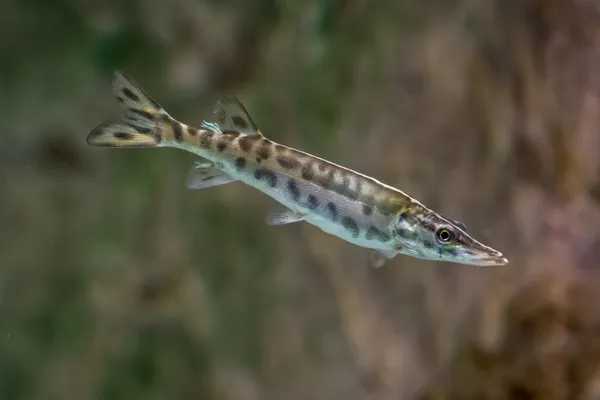
Look at the side of the fish. A northern pike has light spots on a darker background, and a muskellunge has dark spots or bars on a lighter one. Then look at the tail fin. A muskie's is relatively pointed and a pike's is rounded.
The marks, one at a time
Side pattern
- Northern pike: light spots against a darker background. The upper parts are green or blue-gray, with many roundish yellow spots on the sides.
- Muskellunge: dark spots or bars on a light background.
The Washington Department of Fish and Wildlife describes a pike's spots as round to oval and set in horizontal rows. For muskellunge, the Wisconsin Department of Natural Resources says markings and coloration vary from lake to lake and from fish to fish. The U.S. Geological Survey lists three forms that are sometimes recognized as subspecies: a spotted one, one with bars or diffuse spots and blotches, and one with barring or no pattern.
Fins and tail
- Muskellunge: pointed fins, usually rust colored.
- Northern pike: rounded fins.
The Wisconsin Department of Natural Resources describes the fins this way, and the U.S. Geological Survey applies the same mark to the tail: a muskellunge's tail fins are relatively pointed next to a northern pike's.
Cheek and gill cover
- Northern pike: the cheek is fully scaled, and the gill cover is scaled only on its upper half.
- Muskellunge: the cheek and the gill cover are both scaled only on their upper halves.
Both lines come from the Missouri Department of Conservation's field guide. So look at the lower half of the cheek: it is scaled on a pike and bare on a muskellunge.
Pores under the jaw
- Northern pike: a row of 5 sensory pores along each side of the lower jaw.
- Muskellunge: a row of 6 to 9 along each side.
Missouri's field guide and the U.S. Geological Survey both give these counts, and the Survey puts the pike's at 5 or fewer. Both fish have a large mouth with many sharp teeth, so a photo of the underside of the jaw lets you count without handling the mouth.
Size
The two overlap in size. Missouri's field guide calls the muskellunge the largest of the pikes and says the northern pike is usually smaller, yet it gives the northern pike a length of more than 4 feet and a weight of more than 40 pounds, and it puts muskellunge in Missouri at 36 to 45 inches commonly and up to 48 inches.
Where each one lives
Range only hints at the species. The U.S. Geological Survey gives the northern pike a native range across the Atlantic, Arctic, Pacific, Great Lakes and Mississippi River basins, from Labrador to Alaska and south to Pennsylvania, Missouri and Nebraska. The muskellunge's native range is the St. Lawrence River, Great Lakes and Mississippi River basins from Quebec to southeastern Manitoba, south in the Appalachians to Georgia and west to Iowa.
Both now live outside those ranges. Missouri has stocked muskellunge into selected lakes since 1966, and the Washington Department of Fish and Wildlife says northern pike, which are not native there, have spread to several water bodies in the state. Their habitats overlap as well: Missouri's field guide has northern pike preferring waters with dense vegetation and avoiding strong currents, and muskellunge preferring clear water and aquatic vegetation.
The tiger muskie in between
The fish that breaks the pattern test is the tiger muskie, or tiger muskellunge, a cross between a northern pike and a muskellunge. The U.S. Geological Survey says natural hybrids occur in waters where both species are present. The agencies give it these marks:
- dark vertical stripes or bars on a light background, and dark spots on juveniles
- rounded fins, like a pike's
- cheeks that are fully scaled or two-thirds scaled
- 5 to 6 sensory pores
So when a fish has a muskie's dark-on-light pattern but a pike's rounded fins, it may be a tiger muskie. The Survey describes the hybrid as otherwise intermediate between its parents in shape and coloring.
Pickerel, the smaller relatives
Chain pickerel and grass pickerel belong to the same family and have the same body shape. Missouri's field guide separates them from pike and muskellunge at the head: a pickerel's cheek and gill cover are both fully scaled, and it has a row of 4 sensory pores under the jaw. A chain pickerel has a chainlike pattern of dark lines on an olive or yellowish-brown side, and the field guide gives it a total length of 16 to 22 inches. A grass pickerel seldom exceeds 10 to 12 inches and has a dusky bar angling down and slightly back from the eye, which the field guide says a northern pike lacks.
Why the name matters for the rules
Agencies can manage these fish differently, and Washington is one example. Its Department of Fish and Wildlife classifies tiger muskie as a game fish and northern pike as a prohibited invasive species as of 19 November 2026, and says it is the angler's responsibility to know the difference.
That is one state's rule. Rules change and differ from water to water, so check the current rules from the fish and wildlife agency for the place you are fishing. Our guide to size and bag limits explains how these rules work.
Checking a photo with CatchScan
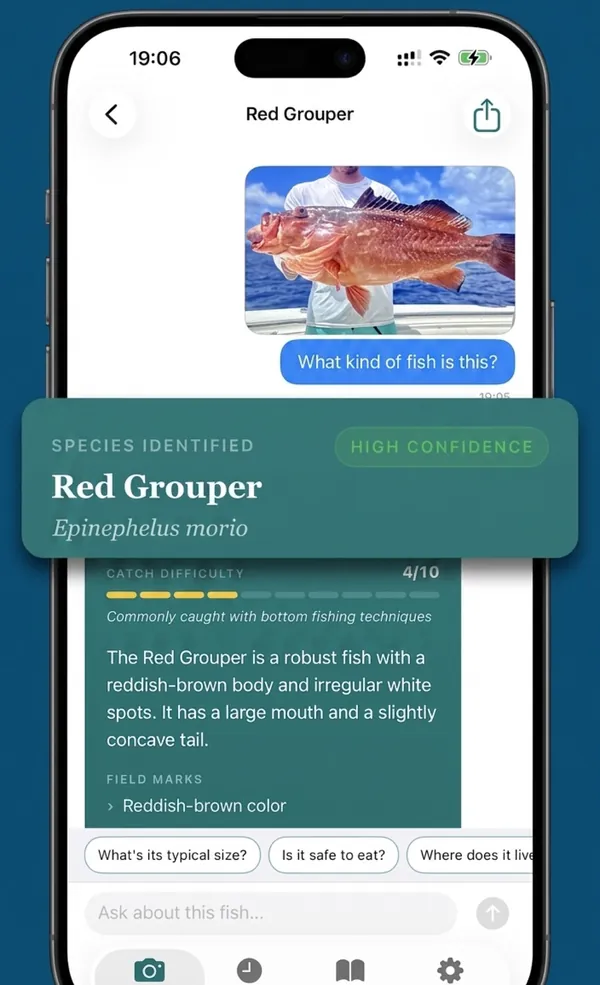
Fish Identifier: CatchScan names a fish from a photo. The result shows the species with a confidence level of high, medium or low. Under "Field marks" it lists the features of the fish it named, and under "Don't confuse with" it names look-alike species with a line on how to tell each one apart.
When the scan has a location, the result can add a "Local regulations" panel, with the date the rules shown were in force. The app is a reference tool and not legal advice. Always confirm with the official authority before you keep a fish.
Whether you check by eye or with the app, a side-on photo shows the side pattern, the fins and the cheek in one frame. Our photo guide covers framing, and the guides to largemouth vs smallmouth bass and other look-alike species cover more pairs.
Sources
- Missouri Department of Conservation, field guide: Northern Pike, Muskellunge, Chain Pickerel and Grass Pickerel, read 19 November 2026
- U.S. Geological Survey, Nonindigenous Aquatic Species: Muskellunge fact sheet and Northern Pike fact sheet, read 19 November 2026
- Washington Department of Fish and Wildlife: Tiger muskie and Northern pike, read 19 November 2026
- Wisconsin Department of Natural Resources: Muskellunge fact sheet (PDF), read 19 November 2026
- Photos from the U.S. Fish and Wildlife Service media library, public domain: Northern pike (Ryan Hagerty/USFWS) and Muskellunge (Brett Billings/USFWS), read 19 November 2026